Overview
Golden Wings is an official Bristell aircraft dealer. The project transformed an existing flight school website into a modern dealership platform that reflects the company's evolving business strategy and positions Golden Wings as a trusted aircraft dealership.
Although it began as a website redesign, the challenge quickly extended far beyond visual improvements. The company's business had changed significantly, which required a complete rethink of the website's purpose, content strategy, information architecture, and user journeys.
My Role
I was the sole Product Designer, owning the end-to-end process: product discovery, stakeholder interviews, UX strategy, information architecture, wireframing, interface design, design-system decisions, prototyping, frontend implementation in Claude Code, and close collaboration with a backend developer on the email submission forms.
Rather than focusing solely on interface design, I approached the project from a product perspective, aligning business goals, customer needs, and technical constraints so the website supports both users and the company's long-term strategy.
The Challenge
The original Golden Wings website was built to promote the company's flight school: pilot training programs, flight packages, and the hours required for certification.
As the business evolved, the flight school became an independent product with its own website. On the new Golden Wings site it remains only in the background, as a partnership rather than the focus. That left the original site serving a purpose that no longer matched the company's goals.
This shift fundamentally changed the product. It was no longer a redesign of an existing website but the creation of a completely new experience, built around a different audience, different business objectives, and an entirely new customer journey.
Users
The new site is built for prospective aircraft buyers: pilots and owners researching a significant, high-trust purchase.
Buying an aircraft is nothing like buying a product online. Customers spend weeks or even months researching models, comparing configurations, and building trust before they ever contact a dealership. The website had to support that long, considered journey, educating, reassuring, and gradually guiding them toward making contact.
The job they're hiring the site to do is to make a confusing, high-stakes purchase feel understandable before they ever pick up the phone: what a model actually costs configured the way they want it, what happens after they reach out, and whether this dealership is one they can trust with the decision.
Research & Discovery
I focused on understanding the business itself. I audited the existing website, documented assumptions and open questions, and built a structured interview framework for the stakeholder sessions. Instead of asking which pages the site should have, I explored how the dealership actually operates.
The questions I needed to answer:
Key findings
These conversations shaped the experience: the site had to educate buyers, build confidence, and support a consultative sale, not behave like e-commerce.
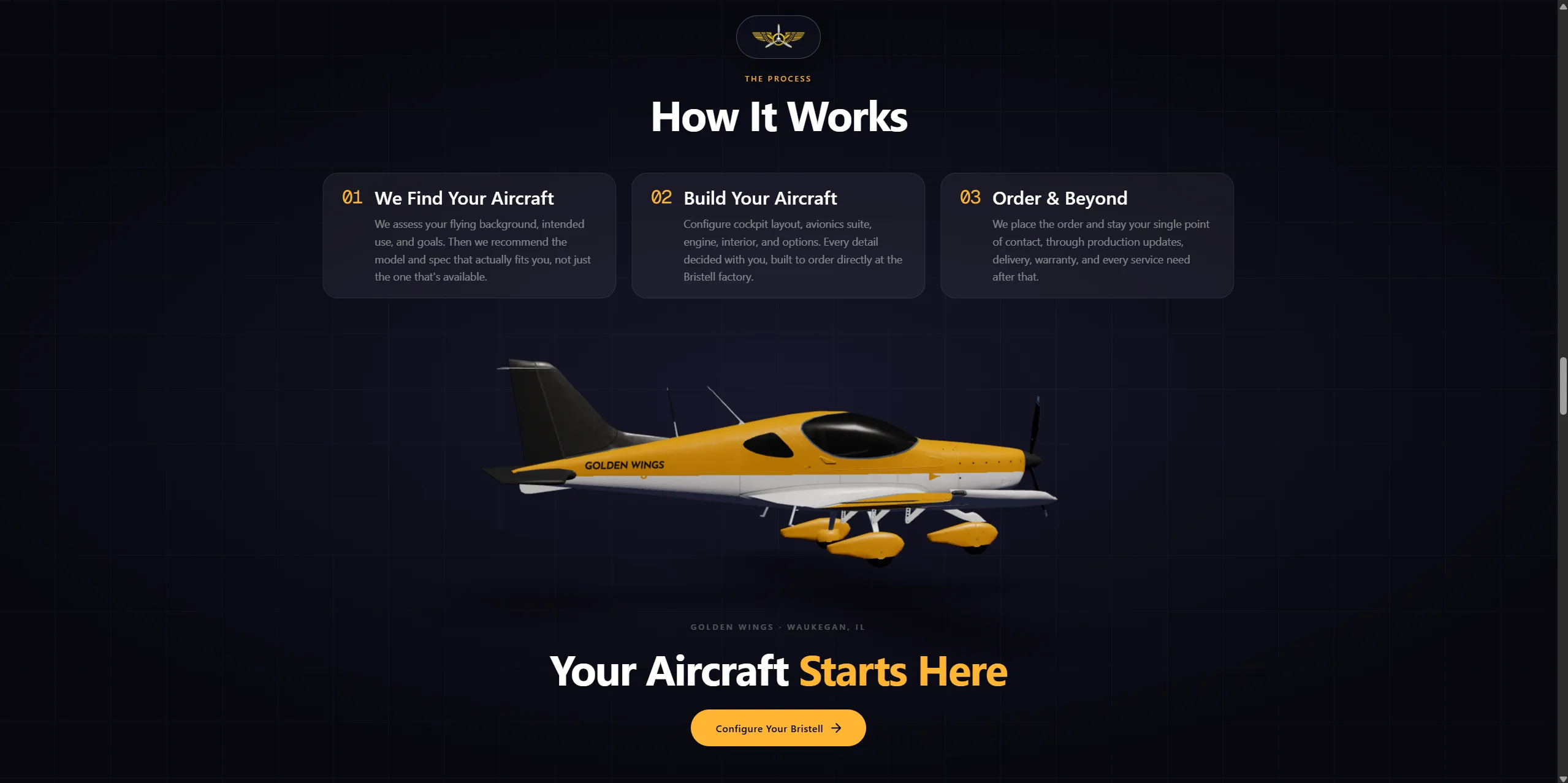
One issue kept coming up: buyers did not know how purchasing an aircraft works or what happens after the first inquiry. A "How It Works" section now shows the journey in three steps, from finding the right aircraft to delivery and service, backed by an updated FAQ and detailed aircraft pages.
Problem & Goal Statement
That research sharpens into a precise statement and a clear goal to design against.
Key Decisions
Design Process
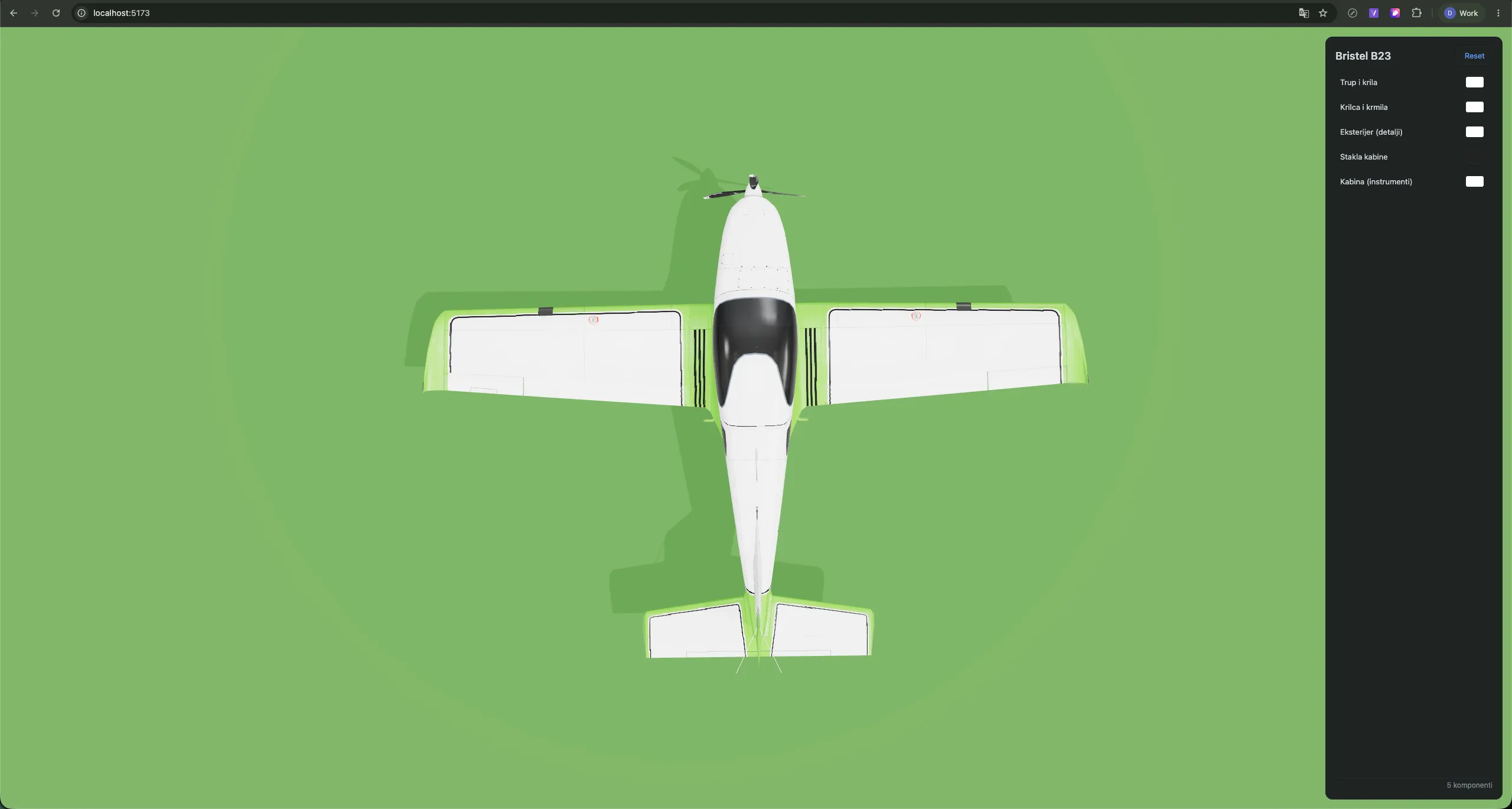
The configurator is built on a 3D model of the aircraft, but that model arrived with no color mapping at all: by default it rendered flat green, with none of the liveries and patterns a real Bristell carries. A configurator only works if every part of the aircraft can be identified and painted independently, and the model had none of that. The fuselage, wings, control surfaces, and detailing all read as one flat surface, and the patterns a Bristell actually wears simply were not there. A single color overlay could not solve any of it, so the work had to start in Adobe Photoshop.
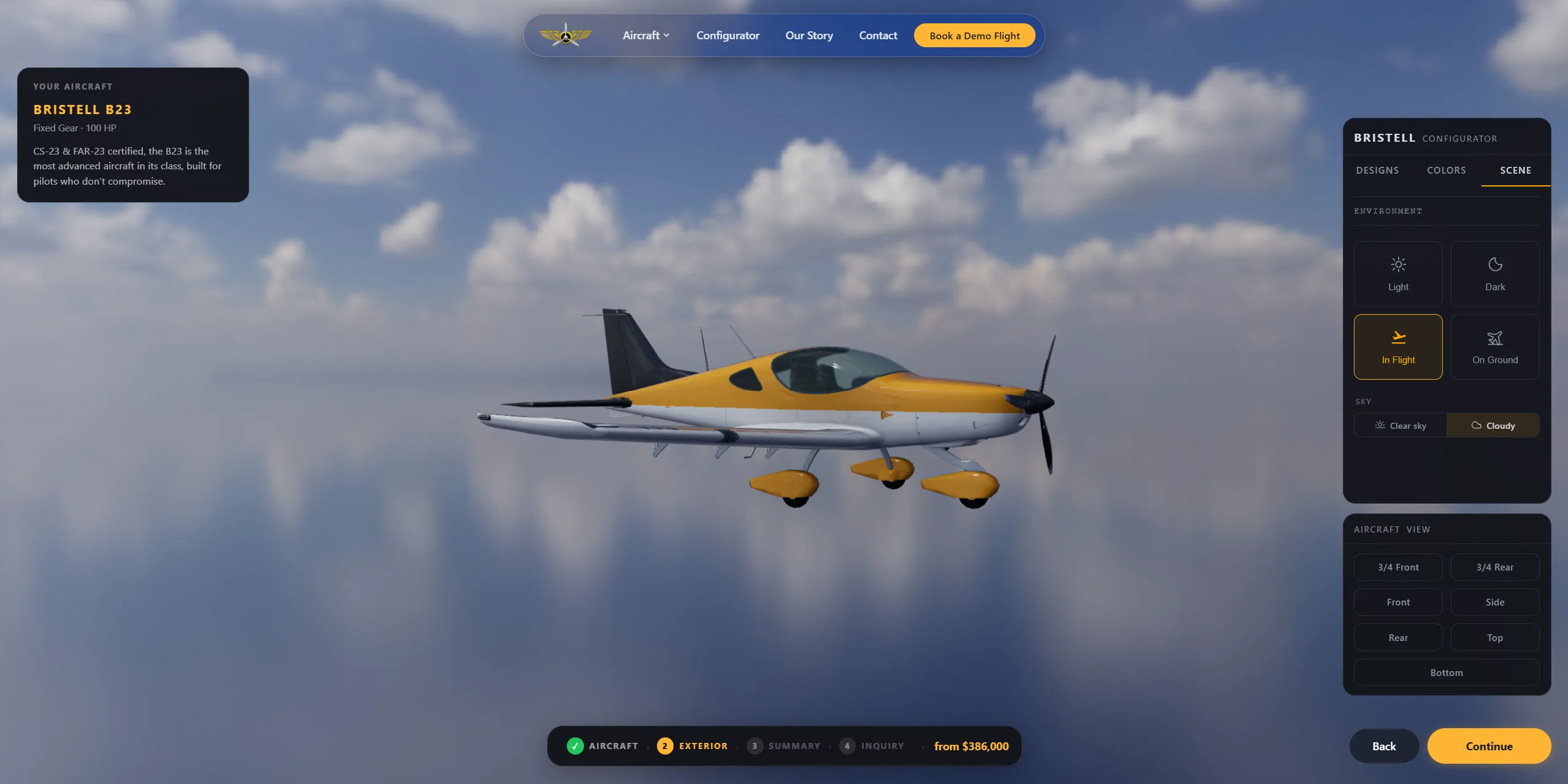
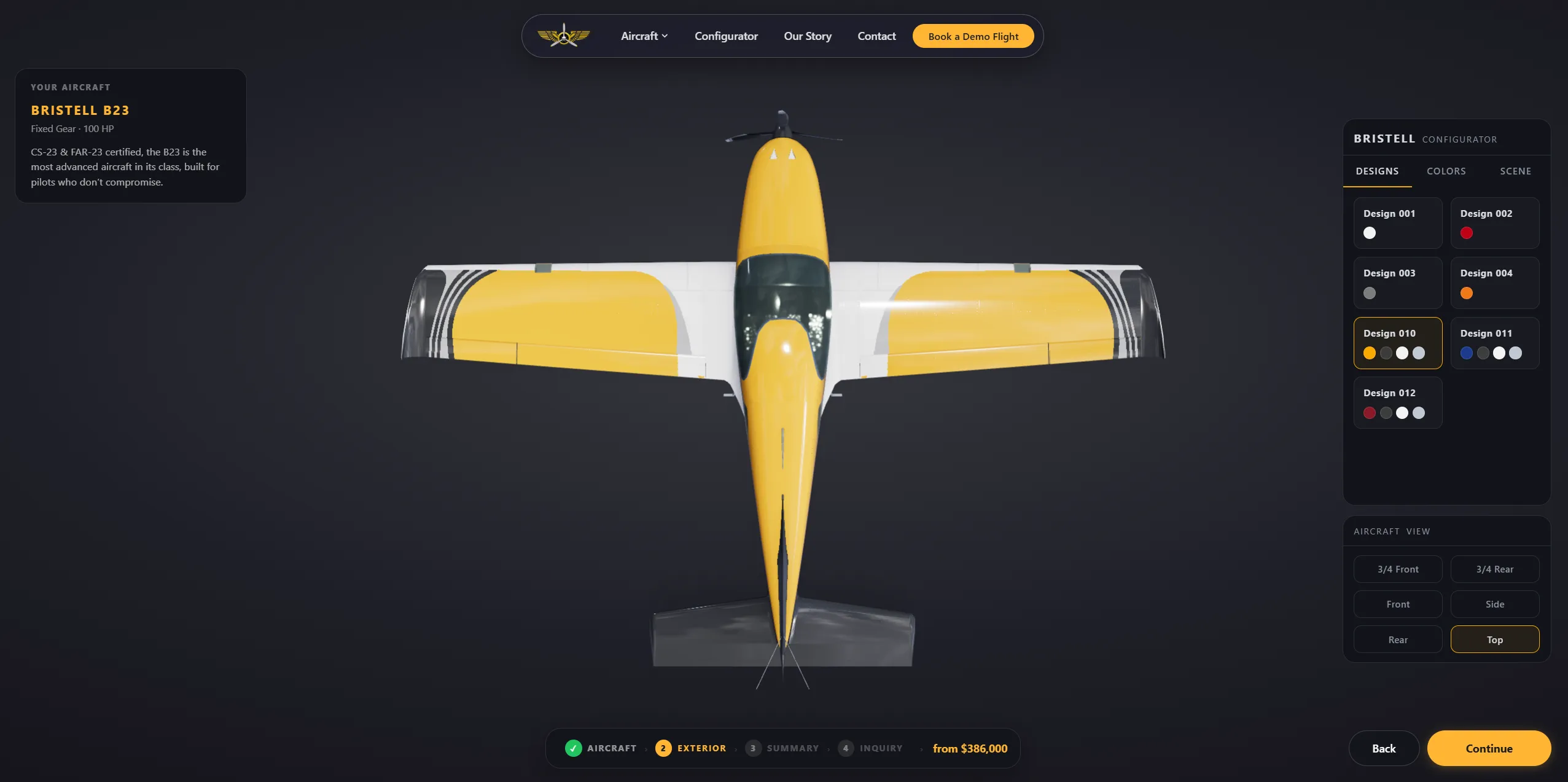
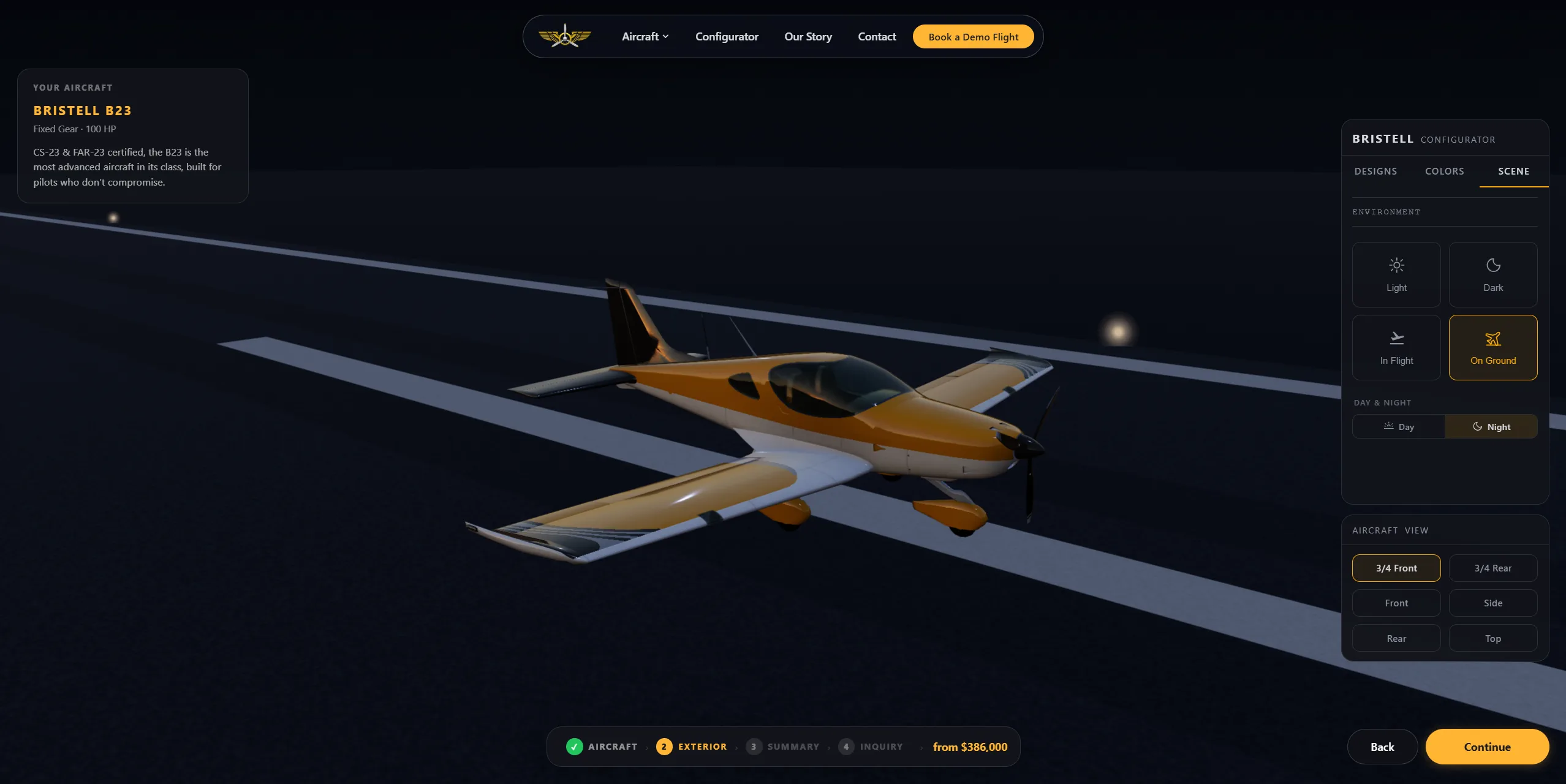
The aircraft also needed a world to live in, so I designed the scenes it is presented in, in flight and on the ground, across day and night, so a premium aircraft always appears in a premium setting. Alongside that, I worked with Claude Code to push the visual quality of the model itself well beyond its raw state, refining how it reads until the flat green placeholder became the premium, recolorable aircraft shown below.
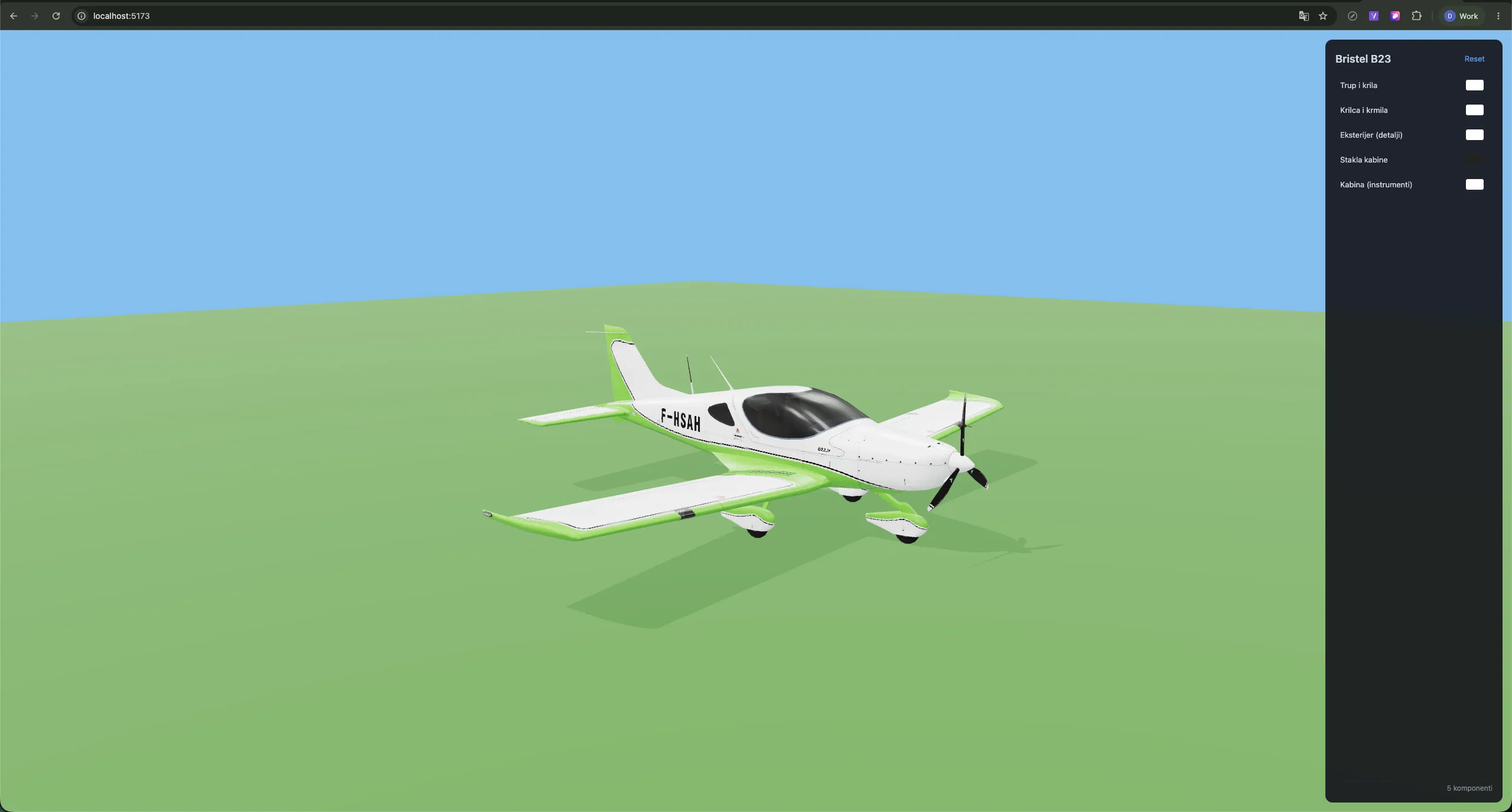
This is where my graphic design background did the heavy lifting. I worked in the model's UV layout, the aircraft's surface unwrapped flat, and in Photoshop I painted the full livery as a single base-color UV texture, hand-drawing the patterns the 3D model never had. The hardest part was that the UV layout came with no numbering or labels at all: nothing told me which flat island belonged to which part of the aircraft. I had to work that out entirely on my own, reading the unwrapped texture piece by piece and matching each region to the real fuselage, wings, control surfaces, and detailing. That is exactly why I wrote a number on every region: it was the only way to keep track of which piece was which and to give the model a reliable way to identify each part. I then loaded that numbered map, built in the same UV space as the base color, back onto the 3D model. With every part identified, the configurator, driven by Claude Code, can recolor the right component live. Getting it right part by part, across multiple models, was by far the most complex and detailed work in the entire project, and it is what makes the aircraft look real rather than a flat green placeholder.
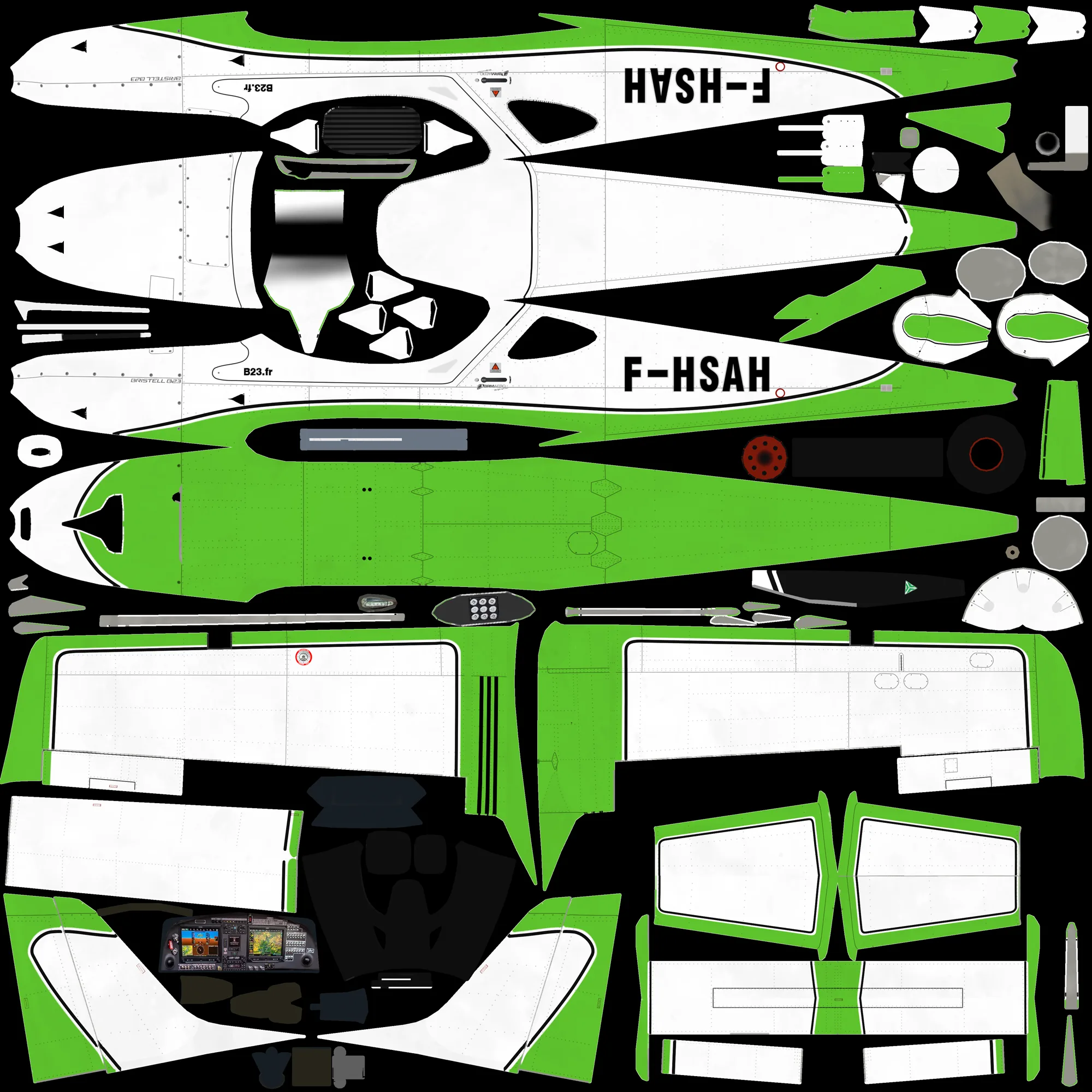
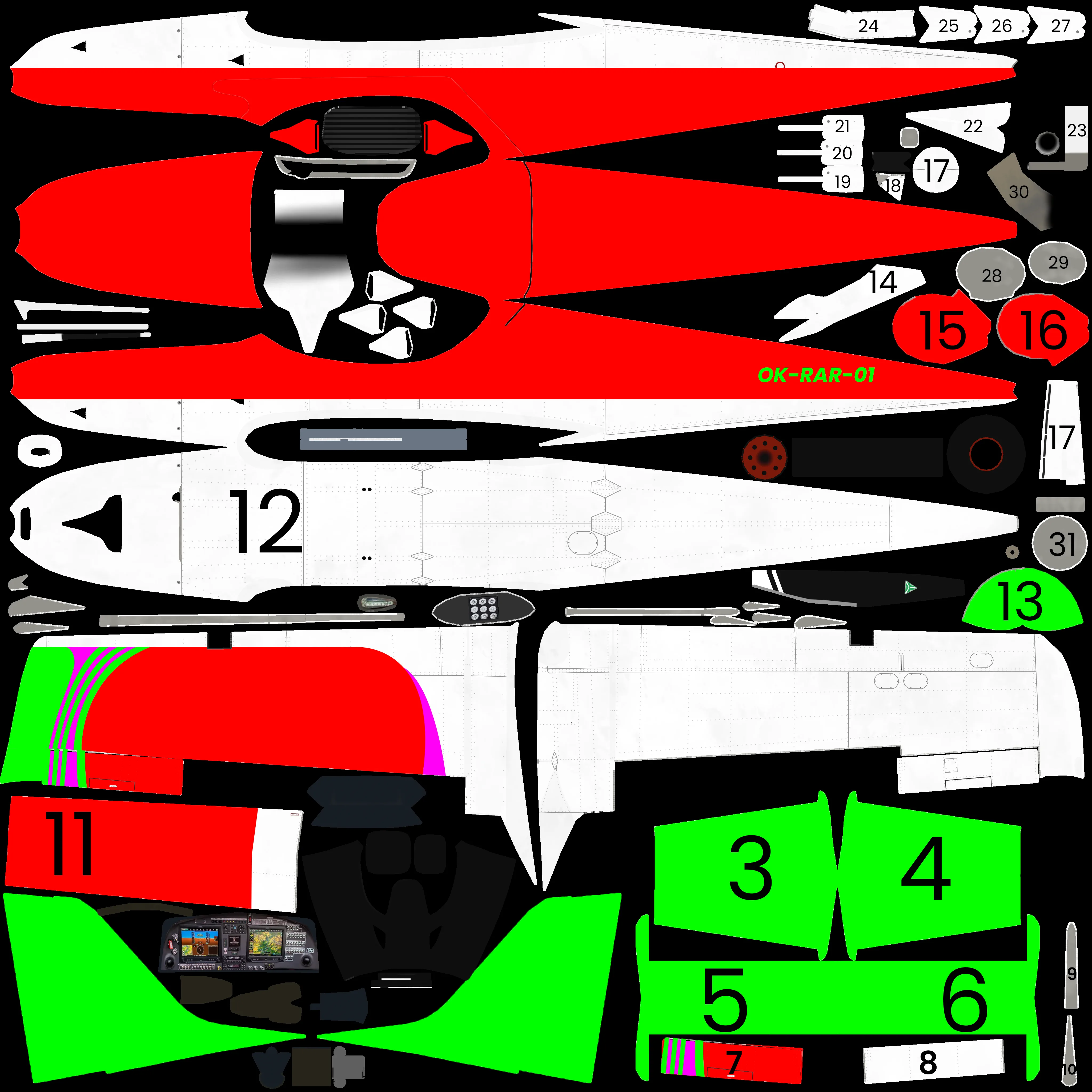
These are raw process materials, not final screens. Some areas of the model had no pattern at all, like the top of the wings, so I drew the livery in by hand and checked the mapping held from every angle. Below is the same top view before and after that work, from a blank surface to a finished Bristell.
Adapting the experience for mobile
The entire site is responsive, but the configurator gave me the most trouble by far. It is the heaviest part of the site, and fitting a full 3D aircraft together with all of its controls onto a small screen ran into problem after problem. On desktop the aircraft sits beside a full control panel; on a phone there is no room for both, so the aircraft keeps the screen to itself while the controls collapse into a compact bottom bar. Designs, Scene, and Colors each open as a focused bottom sheet.
Getting there took round after round of fixing: keeping every control reachable with one thumb, making the bottom sheets feel natural, and above all keeping the heavy 3D model rendering smoothly on mobile hardware without the layout breaking. The pairs below trace that journey, the early in-browser builds beside the finished mobile site.
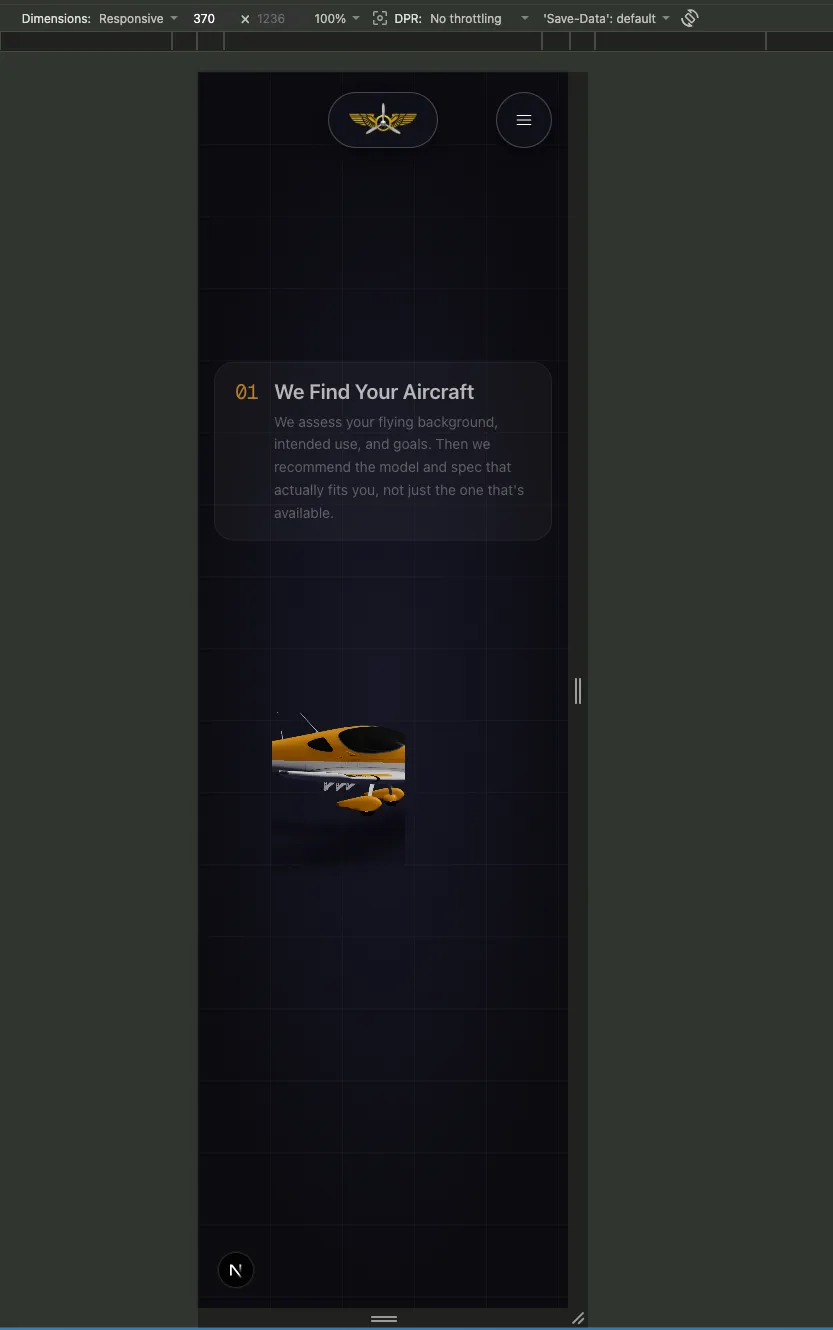
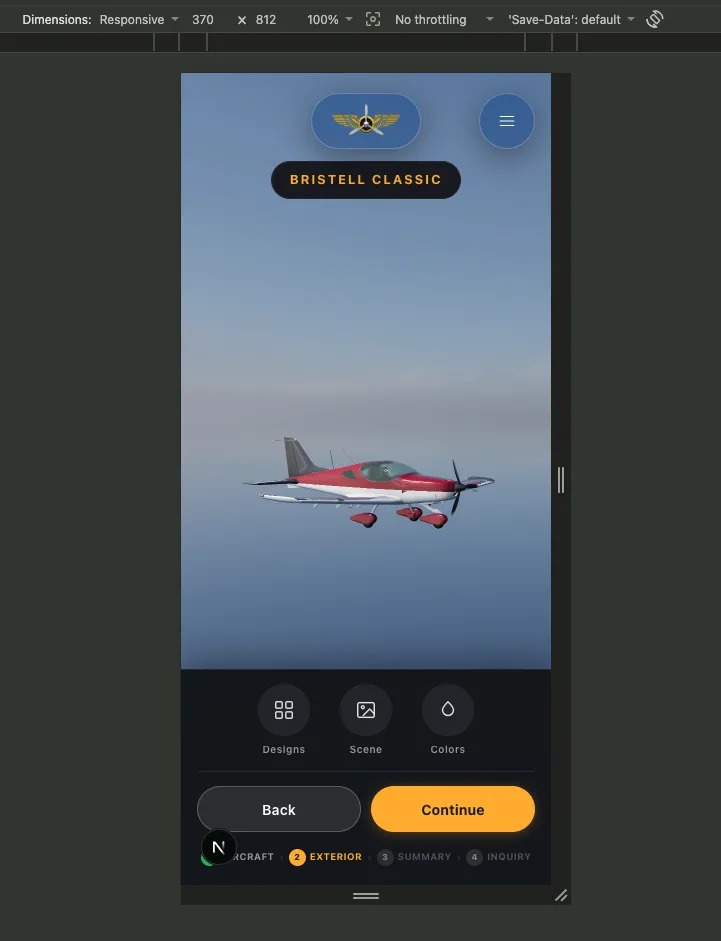
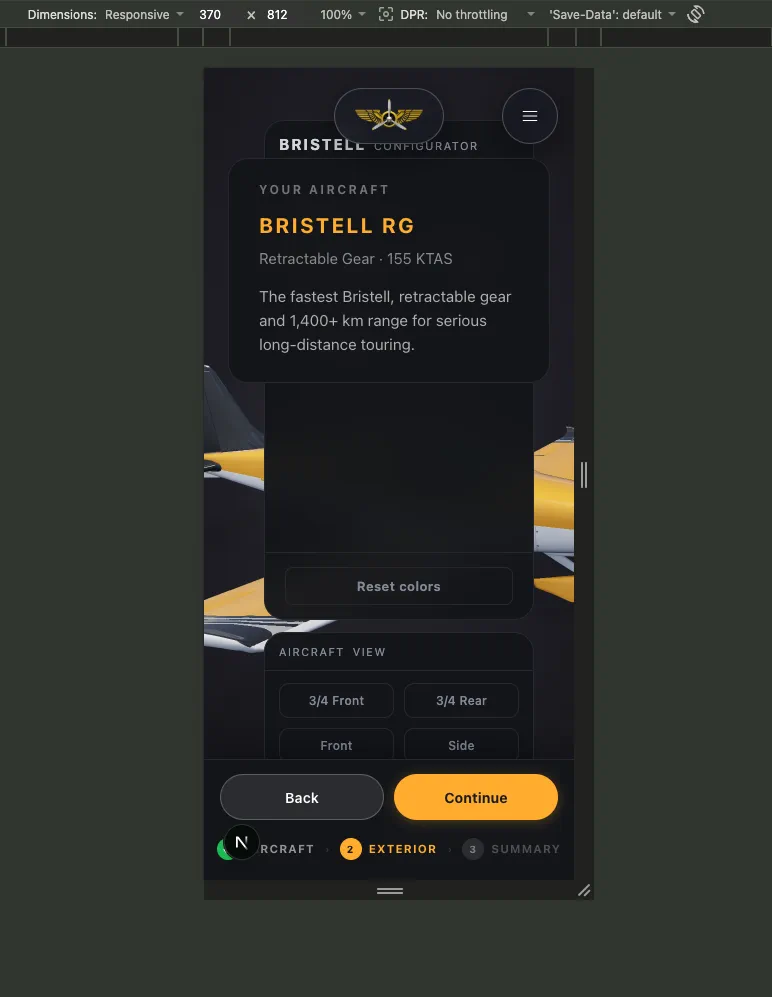
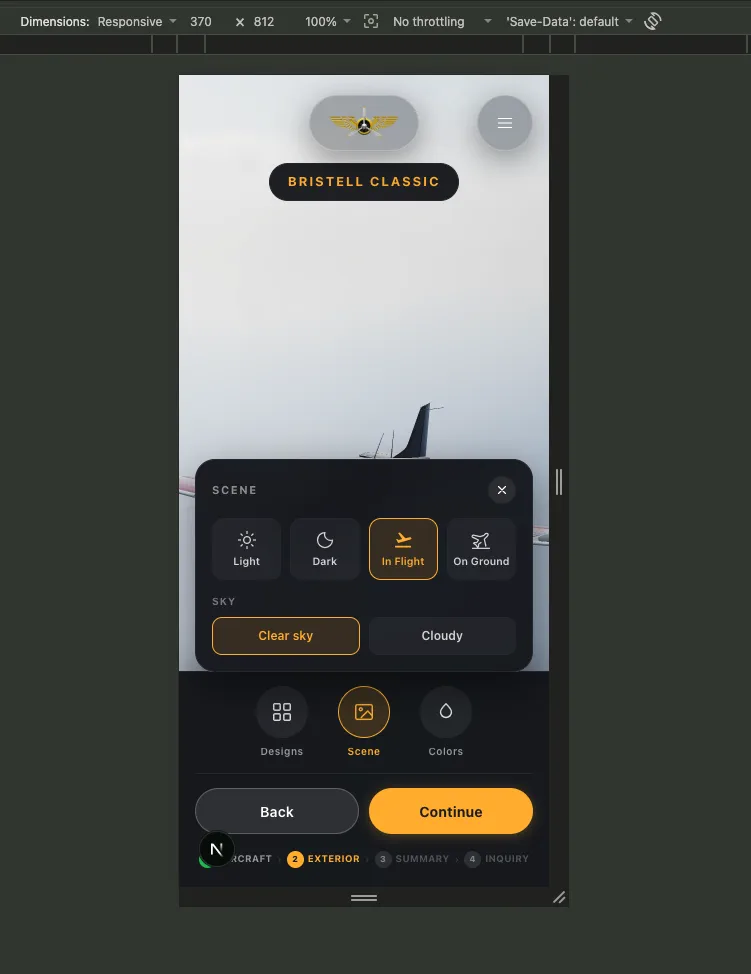
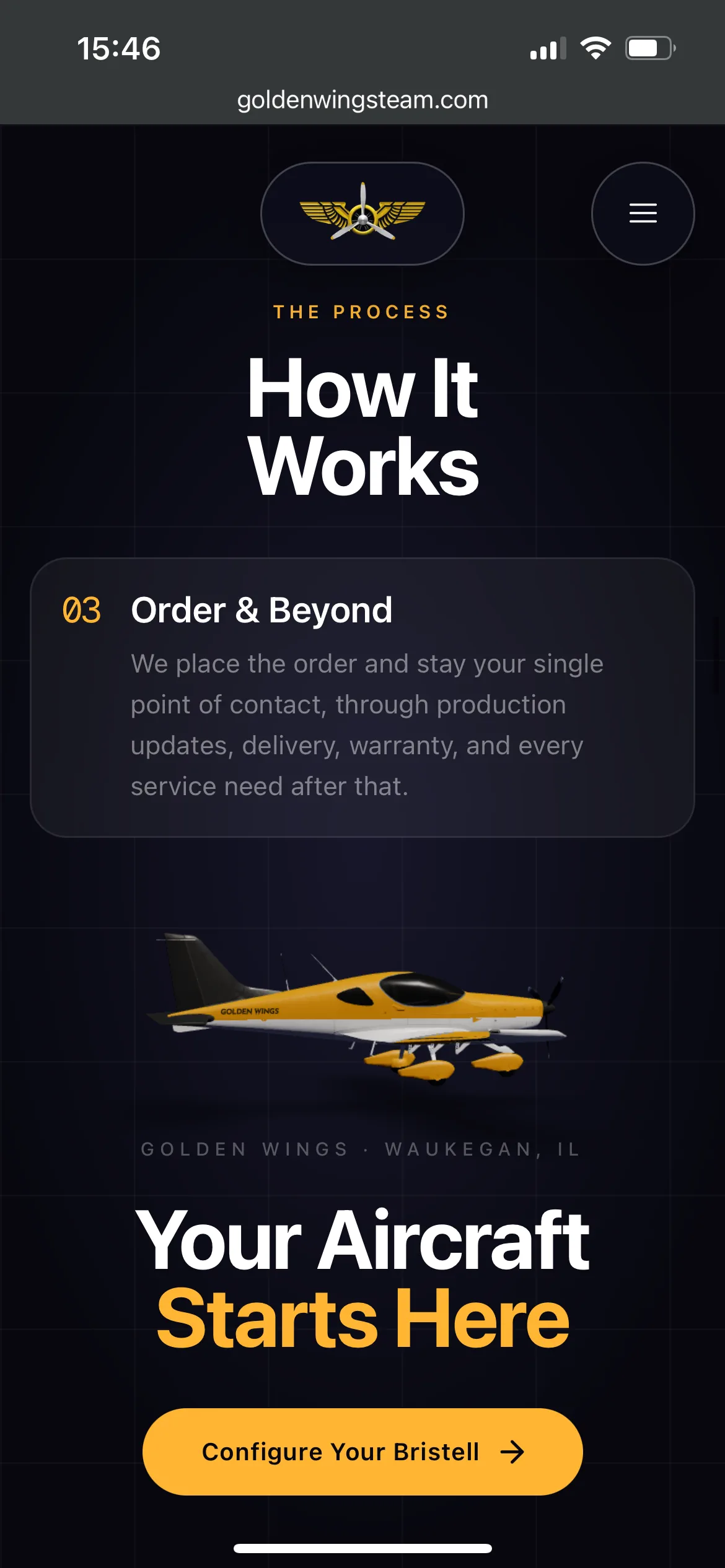
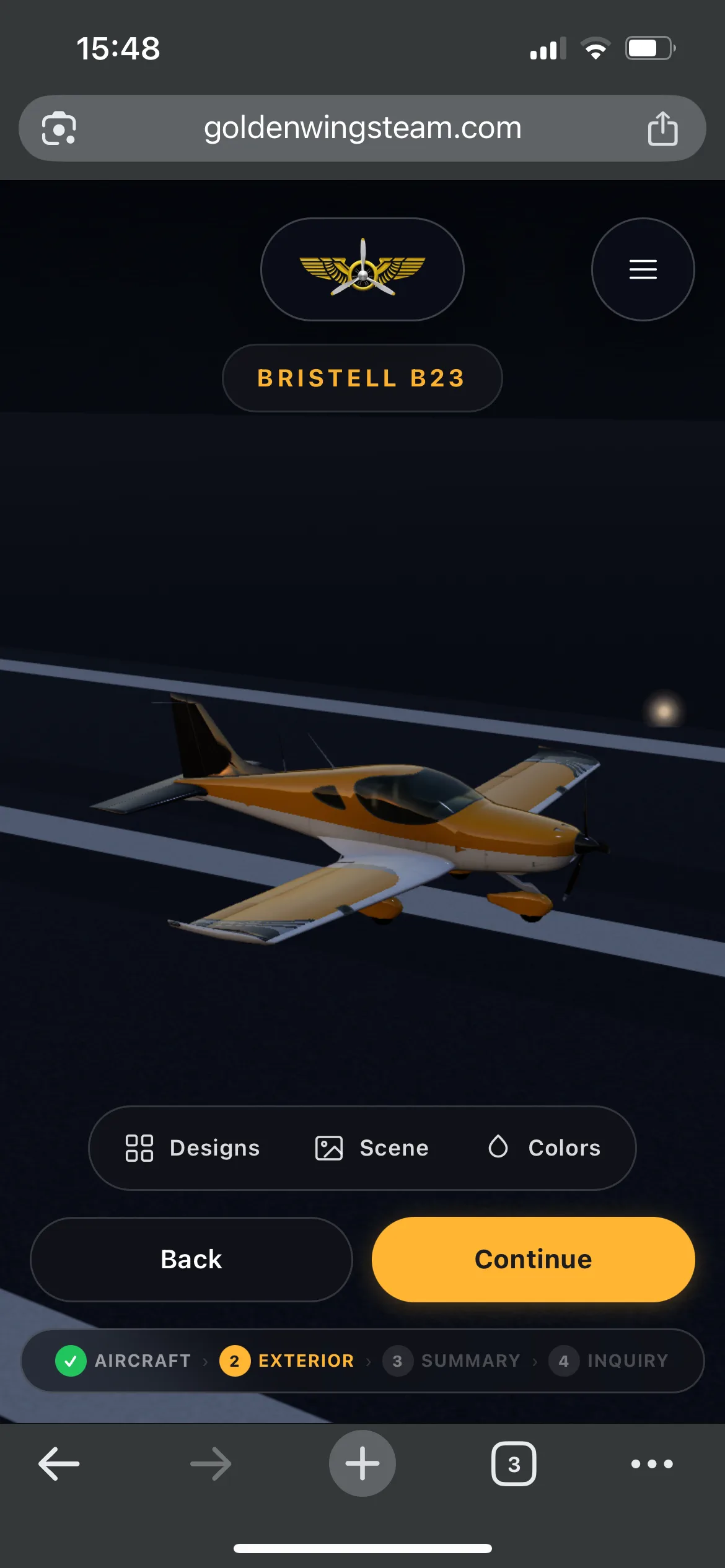
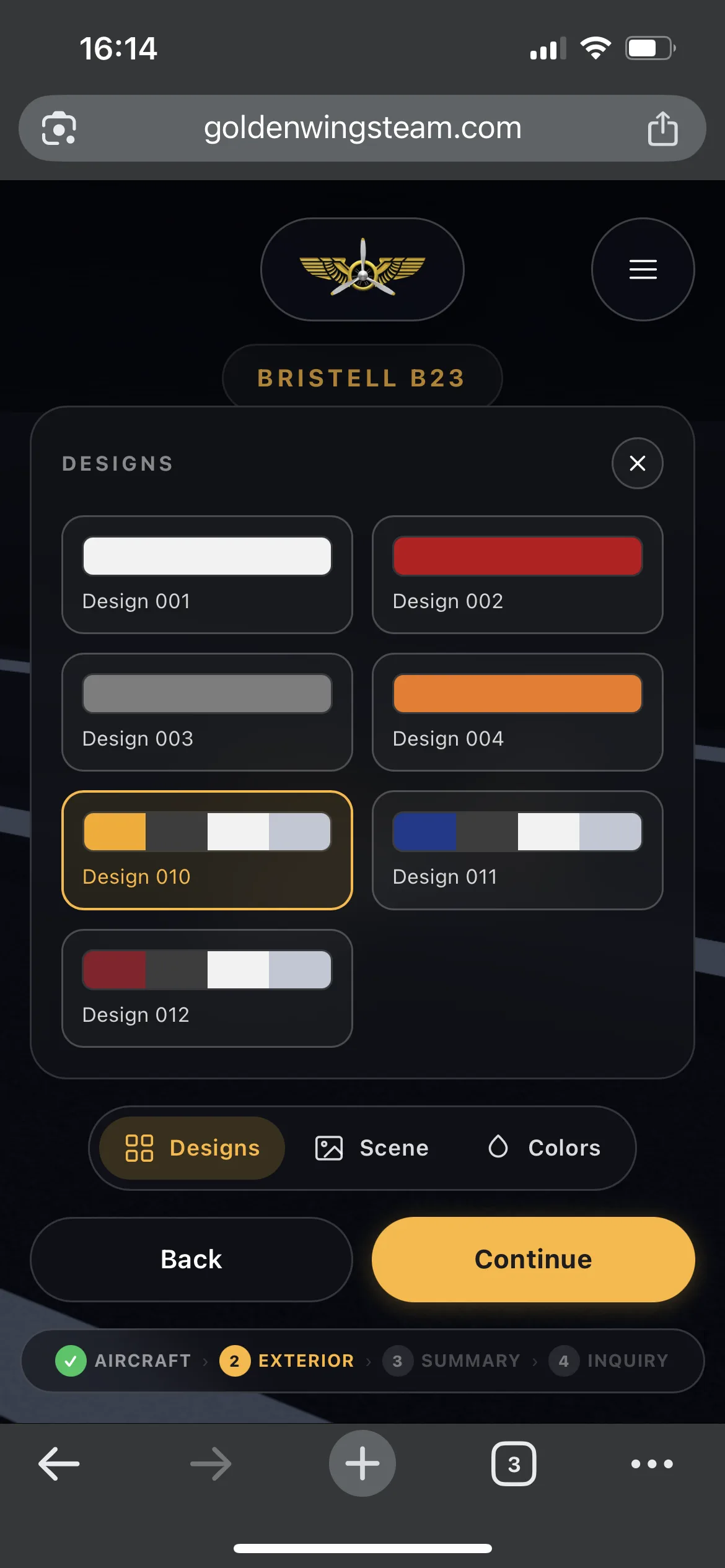
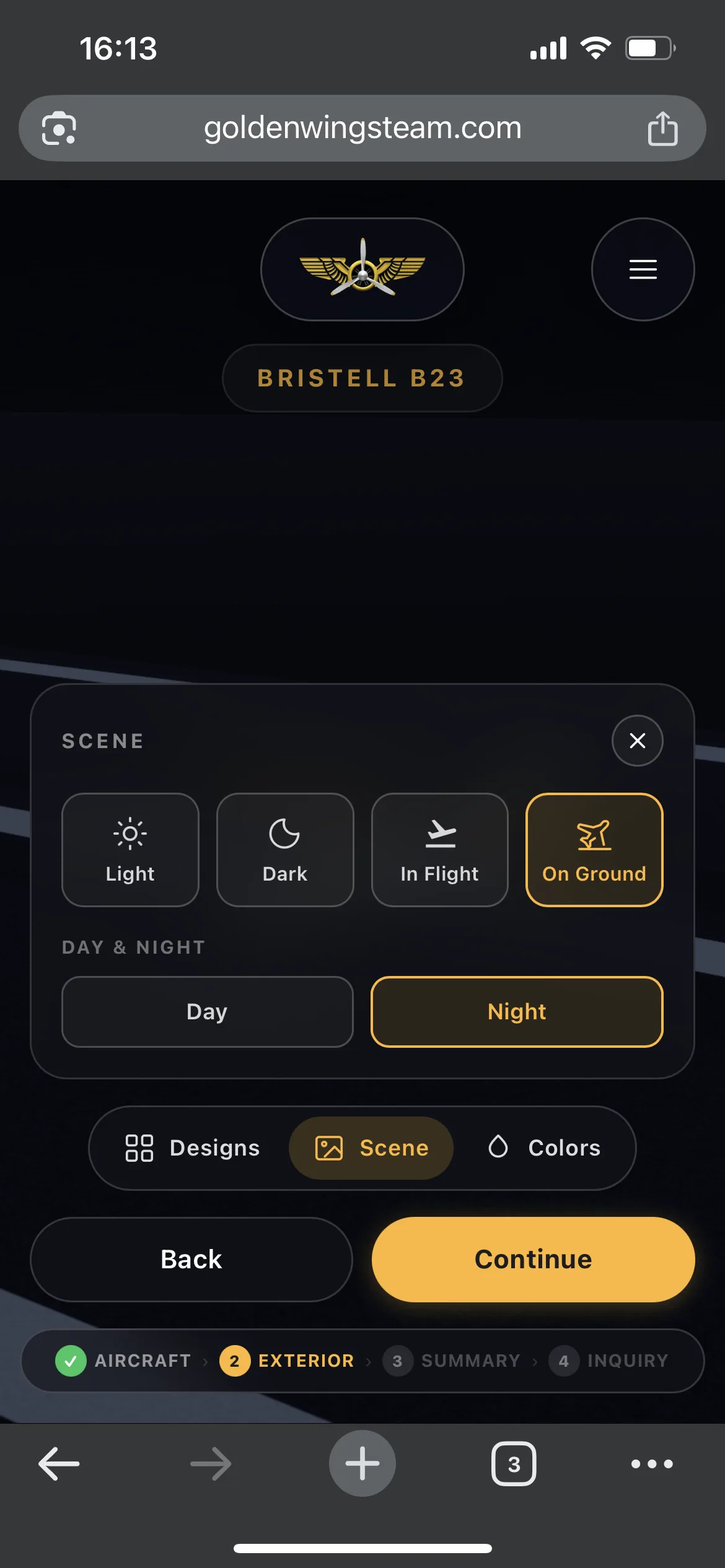
That groundwork is what the finished design, shown next, is built on.
The Solution
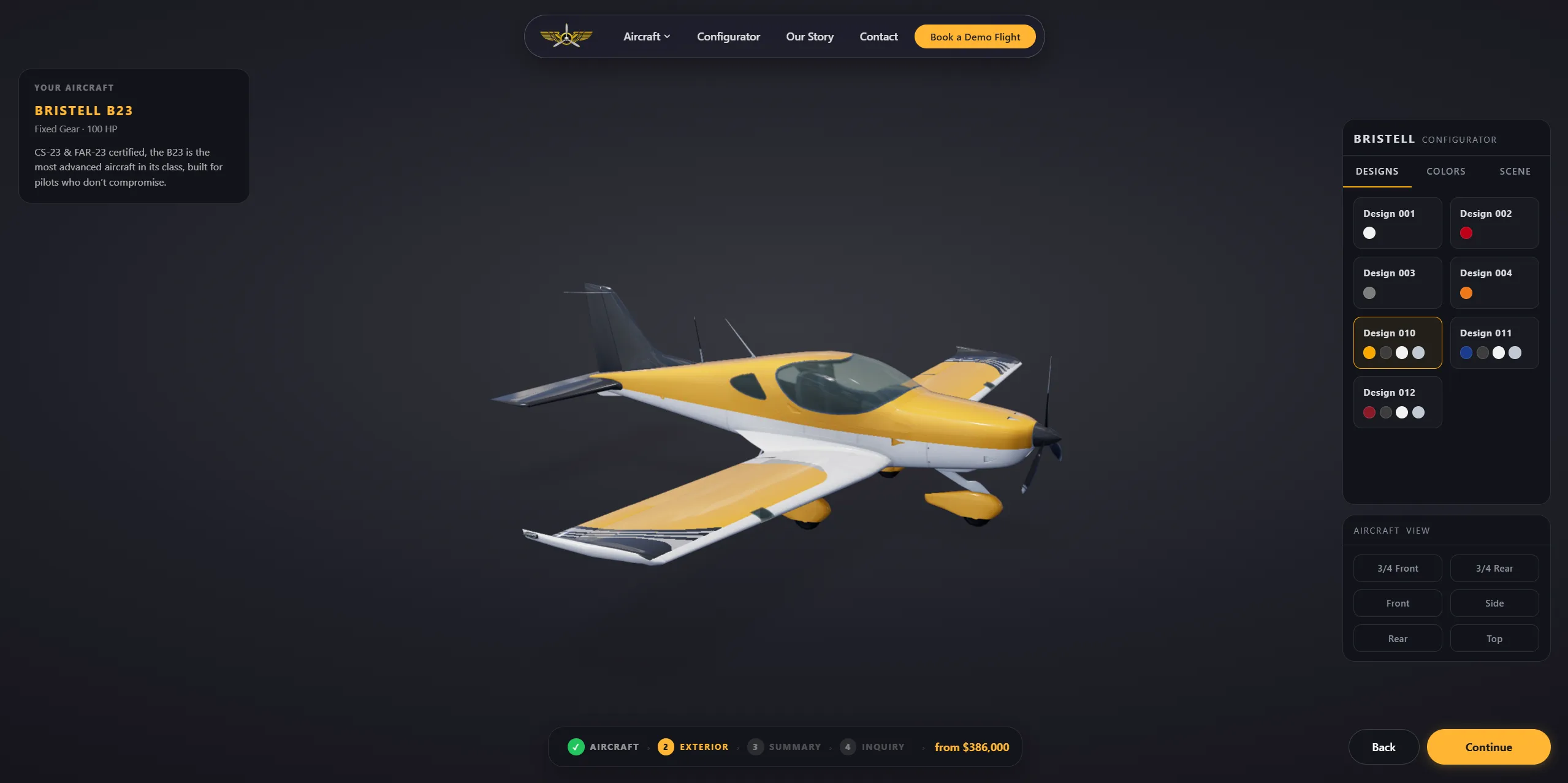
With that groundwork in place, the redesign delivered a premium dealership experience. At its center is the finished aircraft configurator, something the old site never had. The rebuilt homepage and aircraft pages follow, shown before and after.
The aircraft configurator
The configurator turns a static catalog into a hands-on experience: seven configurable Bristell models, a guided four-step flow, and a live preview that updates as buyers change colors and finishes. The previous website, built to promote a flight school, had nothing like it.
The redesigned pages
Beyond the configurator, the homepage and aircraft pages were rebuilt from the ground up. The clearest way to see the shift is side by side: the old flight-school site against the new dealership experience.
Outcome
The redesign moved Golden Wings from an outdated flight-school website to a premium dealership platform that matches where the company is heading.
The clearest measure of success was the client's own reaction.
"I never even dreamed I would have a website like this."
Golden Wings, client
In the first month after launch, Golden Wings sold 5 more aircraft than in a typical month, the client's own figure. Metrics on inquiries and configurator completions are still being gathered and will follow over time.
What I Learned
Reframing comes before designing. This project pushed me to work as a product designer, not only a UI designer. The real problem was a business that had outgrown its website, and the most valuable work was reframing the site around a new audience before designing a single screen.
Effortless interactions rest on careful groundwork. The configurator's color mapping was the steepest technical challenge. Preparing each aircraft's parts in Photoshop and handing that mapping to Claude Code taught me how much careful, unglamorous groundwork sits behind an interaction that feels effortless.
Good documentation makes building solo possible. Designing and building in Claude Code, supported by structured documentation, let me move from strategy to a live, working product largely on my own, while collaborating with a backend developer where it mattered most.
Because the site has only just launched, I do not yet have real usage data. With time, I'd track configurator completions and inquiries, then refine the flow and the aircraft pages based on where real buyers hesitate, rather than on assumptions. I'd also revisit the configurator for buyers on older devices or without WebGL support, and for anyone sensitive to motion, neither was addressed in this first build.